The Story of Bamboo Craft in Odisha
Across villages and rural landscapes around the world, bamboo has long been valued for its remarkable versatility. In Odisha, this relationship between material and making has given rise to a rich tradition of bamboo craft in Odisha, shaped by generations of artisans and their intimate understanding of bamboo. From everyday baskets and household objects to intricate bamboo handicrafts, the material has found a place in both utility and design.

Across villages and rural landscapes around the world, bamboo has long been valued for its remarkable versatility. In Odisha, this relationship between material and making has given rise to a rich tradition of bamboo craft in Odisha, shaped by generations of artisans and their intimate understanding of bamboo. From everyday baskets and household objects to intricate bamboo handicrafts, the material has found a place in both utility and design.
At BEADS, this living craft tradition aligns with a belief in thoughtful, locally rooted design, creating contemporary objects while supporting the artisans and skills behind them.
A Material Woven Into Everyday Life
Long before bamboo became a material associated with contemporary sustainable design, it was simply part of everyday life. Across Odisha’s rural and tribal communities, its strength, flexibility and availability made it an adaptable material for baskets, mats, storage containers, furniture, agricultural tools and household objects. These qualities have allowed traditional bamboo craft to remain closely connected to everyday needs, while its renewability has made it a natural choice for sustainable handicrafts.
What makes bamboo especially fascinating is how much can emerge from a single material. Once harvested, it can be split into strips of varying thickness, shaped, bent, woven and finished according to the object being made. Over time, this understanding of bamboo has extended beyond utility. Its natural texture, warm tones and ability to filter light have opened new possibilities in contemporary design. What was once woven primarily for everyday use can now shape the atmosphere of a modern home, without losing the character of the material itself.
From Bamboo to Craft: The Skill Behind the Making
Odisha has a particularly rich relationship with bamboo. The state has extensive bamboo resources, with several species growing naturally in its forests. This availability has supported a diverse range of craft communities in Odisha, each developing objects, forms and techniques suited to local needs. For artisans, the material is not simply a resource; working with it is part of the artisan livelihoods.
The making begins with selecting and preparing the bamboo, followed by cutting and splitting it into strips of different widths and thicknesses. These are then softened, shaped, bent or woven depending on the object.
In Odisha’s handicrafts, this process can result in intricate geometric patterns, where the crossing strips create both structure and ornament. The finished form may look effortless, but every curve, joint and intersection reflects a practiced understanding of the material.
Many Regions, Many Expressions of Bamboo Craft
The diversity of Odisha crafts lies not only in the materials used, but in the many ways communities have learned to work with them. Across the state, bamboo takes different forms depending on local practices, needs and the skill of the artisans who shape it. From woven baskets and mats to storage objects, furniture and decorative pieces, Odisha handicrafts demonstrate how one material can hold many possibilities.
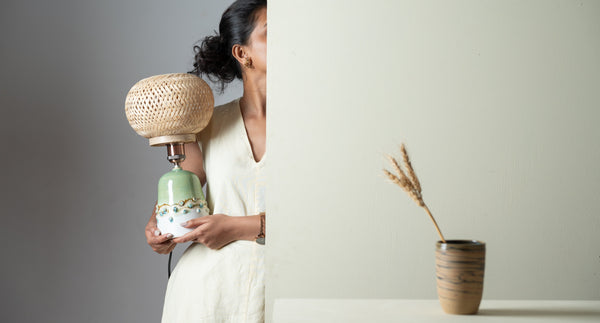
In Khordha, for instance, this craftsmanship takes on a contemporary expression through bamboo lighting. A team of local artisans, led by master craftsman Ekadasi Barik, works with the traditional basket-weave technique to create intricate shades. Each strip is carefully interlaced into a unique pattern, allowing the natural bamboo to filter light and create a warm interplay of illumination and shadow.
Bamboo Weave Lamps by BEADS
At BEADS, bamboo craft finds a contemporary expression through lighting; bringing the skill of Odisha’s artisans into spaces that value natural materials, thoughtful design and slower ways of making. Our collection explores how a traditional weave can shape not only an object, but also the quality and character of light.
Madhukara Bamboo Weave Pendant Lamp
Inspired by the geometry of a honeycomb, Madhukara lamp pairs a hexagonal bamboo weave with ceramic details. When illuminated, its lattice casts delicate patterns around the room, turning bamboo lighting into a sculptural experience.
Dīpa Bamboo Weave Table Lamp
Dipa meaning “lamp” in Sanskrit, brings together bamboo weaving, brass and solid wood into one structured piece. Its carefully woven shade softens the light into a warm glow, making it an understated piece of handmade lighting for evening hours.

Ratna Table Lamp
Ratna, meaning “jewel”, blends bamboo weaving together with a sculptural Raku ceramic base. Its geometric honeycomb weave filters the light into soft illumination, creating a distinctive bamboo lampshade that sits between craft and collectible design.

Keeping the Craft in Motion
A craft survives not only when it is preserved, but when it continues to be practised, valued and given a place in everyday life. For bamboo craft in Odisha, this means creating opportunities for artisans to sustain their skills while allowing traditional techniques to evolve with changing homes and lifestyles.
Choosing handmade objects is one way of keeping this process in motion. Unlike mass-produced pieces, every woven object carries subtle variations in its material, pattern and finish, small reminders of the hands and time behind its making. It is a slower, more considered way of creating, where the value of an object lies not only in what it becomes, but also in the skill and labour that bring it to life.
At BEADS, we believe that Odisha’s crafts can find new relevance without losing their connection to place, material and makers. By bringing eco-friendly handicrafts such as bamboo weaving into contemporary spaces, we hope to keep these traditions alive while allowing Odisha handicrafts to evolve, one thoughtfully made piece at a time.